Why Water Pools at Foundations and What It Costs to Ignore
Water gathers at a foundation for three simple reasons: the ground slopes towards the house, roof water dumps beside it, or groundwater rises against it. Any one of these can push moisture through cracks, joints, and porous concrete, and the damage compounds quietly. Damp basements grow mould, wooden sill plates rot, and repeated freeze-thaw cycles widen small cracks into structural problems.
The direct answer is that the best drainage solution is a layered one: start with grading and gutters, add surface drains where water still ponds, and use a French drain or waterproof membrane only when subsurface water is the problem. Fixing the cheap surface causes first often removes the need for expensive excavation, which is why every good drainage plan works from the outside in.
How Does Yard Grading Keep Water Away From Your Foundation?
Proper grading is the cheapest and most effective drainage solution available. The ground should fall at least six inches over the first ten feet away from the foundation, carrying surface water away before it can soak in beside the wall. Homes that settle into a hollow, or where flower beds and mulch have been built up against the siding, reverse this slope and invite water in.
Regrading is straightforward work: add compacted topsoil around the perimeter, shape it into a gentle fall, and keep at least four to six inches of foundation visible above the soil line so siding and timber stay dry. Avoid using loose mulch or gravel against the wall, since both let water through quickly. Where the yard is too small for a full ten-foot fall, a swale or a hardscape slope can do the same job in less space.
The soil itself matters as much as the slope. Heavy clay holds water against the wall, so a cap of compacted clay-rich topsoil near the foundation sheds water better than loose, sandy fill, which lets it straight through. After regrading, watch the first heavy rain: if water still lingers in a dip, top it up and re-compact, because a grading job is only finished when the water visibly runs away from the house.
Gutters, Downspouts, and Extensions That Move Roof Water Away
A single downspout can pour hundreds of gallons of water beside a foundation during a heavy storm, so gutters are drainage, not decoration. Clean gutters twice a year, check that they slope towards the downspout, and make sure joints do not leak. Clogged gutters overflow exactly where the water does most harm: right against the wall.
- Clean the gutters and check the fall towards the downspout.
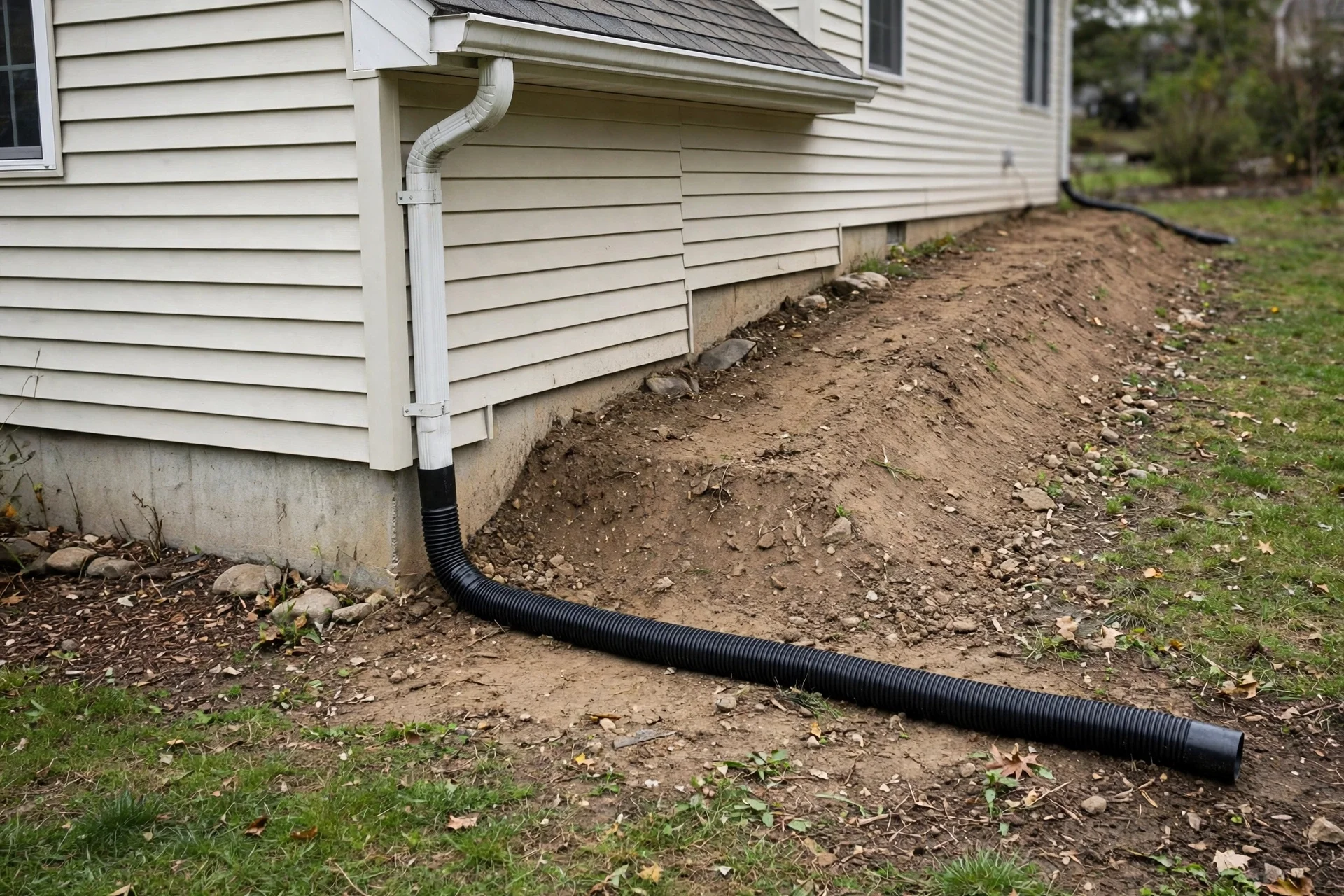
- Fit a rigid extension pipe to the downspout outlet.
- Run the pipe at least six feet from the foundation wall.
- Bury the pipe or anchor it so it cannot shift or crush.
Downspout extensions are the highest-value fix in foundation drainage. Rigid or flexible pipe should carry water at least four to six feet from the house, and ten feet is better on flat ground. Burying the extension in solid pipe to a dry well or a storm drain keeps the yard tidy and stops the pipe from being crushed or tripped over. Splash blocks help, but they are no substitute for getting the outlet well away from the wall.
Sump Pumps and Interior Drain Tile as a Second Line
Interior drain tile and a sump pump manage water that has already got past the exterior defences. A perimeter channel is cut into the basement floor beside the footing, water is collected in a sump basin, and a pump discharges it outside, well away from the foundation. A battery backup keeps the system working through power cuts, which is exactly when the heaviest rain often arrives.
Interior systems do not prevent water from reaching the wall, so they are best used alongside exterior improvements, not instead of them. A pump should be tested twice a year, the discharge line checked for freezing in winter, and an alarm fitted so a failed pump is noticed before the basement floods. In areas with frequent storms, a second pump or a water-powered backup adds real peace of mind.
Choosing the pump itself deserves care. A cast-iron submersible pump lasts longer and runs quieter than a cheaper plastic pedestal model, and a float switch with a solid, non-mechanical design is less likely to stick. Size the pump to the worst storm the area sees, not the average one, and make sure the discharge line has a check valve so water cannot flow back into the basin when the pump stops.
French Drains for Subsurface Water
A French drain is a gravel-filled trench with a perforated pipe that collects groundwater and carries it to a safe discharge point. It works where surface fixes fail: high water tables, springs, hillside seepage, and clay soils that hold water against the wall. Installed around the footing, it relieves the hydrostatic pressure that pushes water through basement walls and floor joints.
A durable French drain is built with rigid perforated pipe laid holes-down on washed gravel, wrapped in filter fabric so silt cannot clog it, and given a steady fall of about an inch per eight to ten feet towards daylight or a sump. Flexible corrugated pipe and missing filter fabric are the two most common reasons these systems fail early. Expect a professionally installed perimeter drain to cost a substantial sum per linear foot, varying widely by depth and access.
Surface Drains, Catch Basins, and Channel Drains
Where water ponds on driveways, patios, and walkways, surface drains catch it before it reaches the foundation. A catch basin is a small underground box with a grate that collects water from a low spot and sends it through solid pipe to a discharge point. Channel drains, the long narrow grates seen across driveways, intercept sheet flow from a slope before it can run against the house.
These systems need regular cleaning, since leaves and silt settle in the basins and block the outlet. Choose grates rated for the traffic they will carry, and connect the outlet to daylight or a storm drain rather than to a French drain, which is designed for groundwater, not for sudden surges of surface water. On a flat lot, a well-placed catch basin can solve a pooling problem that grading alone cannot.
- Pick grates rated for the traffic crossing them.
- Clean catch basins every autumn and spring.
- Send the outlet to daylight, never into a French drain.
Swales and Berms That Work With the Landscape
A swale is a wide, shallow, grassed channel that slows runoff and guides it around the house to a safe area. Unlike a ditch, a swale looks like part of the lawn, and it can be planted with moisture-tolerant grasses that help the water soak in slowly. Berms are the opposite: low mounds of soil placed uphill of the house that intercept runoff before it arrives.
Both features suit larger properties and hillside sites, where regrading alone cannot redirect the volume of water coming down a slope. A swale needs a continuous gentle fall to work, and it must not direct water towards a neighbour’s property. Local rules sometimes govern where runoff may be sent, so check before reshaping drainage that crosses a boundary.
Waterproof Membranes and Dimple Boards
When water pressure against a below-grade wall is the problem, a waterproof membrane on the outside of the foundation is the most thorough answer. Liquid-applied elastomeric membranes and peel-and-stick sheets create a seamless barrier over the concrete, and a dimple board fixed over the top protects the membrane during backfilling while giving water a path down to the footing drain.
This is major work, because it requires excavating down to the footing, which is why it is usually done during construction or a major repair. A membrane typically lasts twenty to thirty years, and its weak points are punctures during backfill and poor preparation of the concrete surface. For interior walls, waterproof coatings are a weaker substitute: they manage damp but cannot resist real hydrostatic pressure.
Drainage System Costs and Maintenance in Broad Terms
Drainage costs span a wide range, and the cheapest fixes are usually the most effective. Regrading and downspout extensions are modest DIY or small-contractor jobs, while surface drains and catch basins cost more but remain affordable. French drains, membranes, and sump systems are the expensive end, with per-foot prices that rise sharply with depth, access, and soil conditions, so get several quotes before committing.
Every drainage system needs maintenance to keep working. Clean gutters and catch basins seasonally, check that downspout outlets are clear and still discharge away from the house, and flush a French drain’s cleanouts every year or two. A system that is never inspected will eventually fail silently, and the first sign is usually water where it should not be.
Drainage Safety and When a Foundation Drainage Contractor Should Step In
Homeowners can safely handle grading, gutter cleaning, and downspout extensions, but excavation near a foundation is different. Digging beside a footing can undermine it, and deep trenches can collapse, so footing drains, membranes, and major regrading belong to licensed contractors with shoring equipment and insurance.
Call a foundation specialist if cracks are widening, floors are uneven, doors stick, or water appears after every rain despite surface fixes. These signs can indicate settlement or structural movement, not just poor drainage, and a structural engineer may need to assess the foundation before any drainage work begins. Never divert runoff onto a neighbour’s land or into a public sewer without checking local rules.
Foundation Drainage FAQs
How far should the ground slope away from my foundation?
Aim for at least six inches of fall over the first ten feet from the foundation wall. This is the widely used rule in building guidance, and it is enough to carry ordinary rain away before it soaks in beside the wall.
How far from the house should downspouts discharge?
At least four to six feet, and ten feet is better on flat ground. Roof water is the largest single source of water beside most foundations, so moving the outlet well away often solves a damp problem on its own.
What is the difference between a French drain and a surface drain?
A French drain is buried and collects groundwater through a perforated pipe in gravel, while a surface drain or catch basin collects water that is already flowing across the ground. They solve different problems and should not be connected to each other.
Do I need a sump pump if I have a French drain?
Not always. A French drain that discharges to daylight by gravity needs no pump. A sump pump is needed when the drain cannot fall to a lower outlet, or when the water table is high and water collects below the level of any gravity outlet.
Can poor drainage damage a foundation permanently?
Yes. Repeated saturation and drying cycles cause soil to expand and shrink, which cracks foundations, while constant hydrostatic pressure pushes water through walls and joints. Over years this can lead to settlement, bowing walls, and repairs that cost far more than the drainage would have.
How often should drainage systems be maintained?
Gutters and catch basins need cleaning at least twice a year, and more often under trees. French drains should be flushed through their cleanouts every year or two, and sump pumps tested twice a year, including the battery backup if one is fitted.
Final Thoughts: Keeping Foundation Water Moving Away From Your Home
The best drainage solution is rarely one product. It is a sequence: grading first, gutters and downspouts second, surface drains third, and subsurface systems only where the water genuinely comes from below. Each step is cheaper than the next, and each one makes the next less necessary.
Walk the property in heavy rain and watch where the water actually goes. That single observation, more than any catalogue, will show which fix belongs first, and it turns a vague worry about damp into a clear, affordable plan.